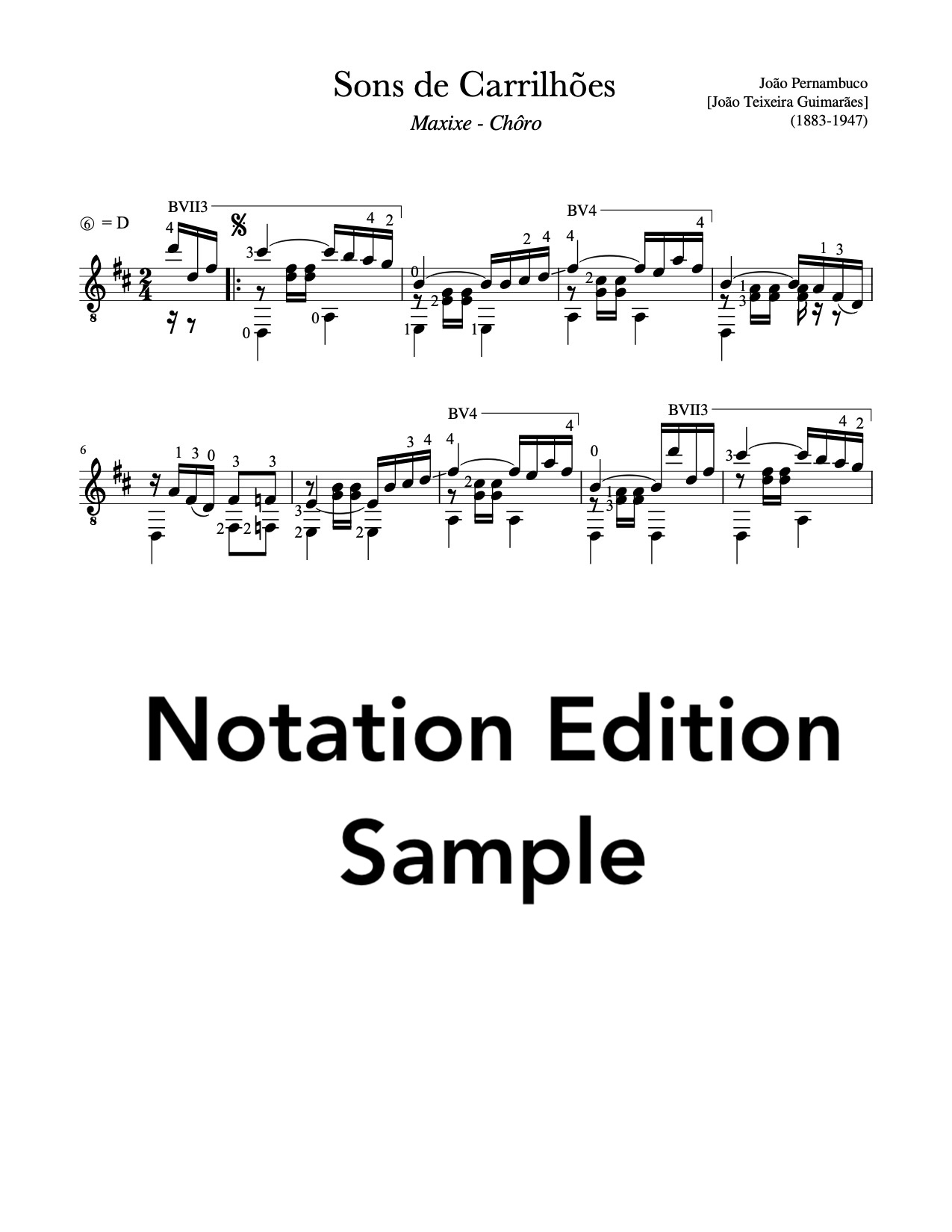
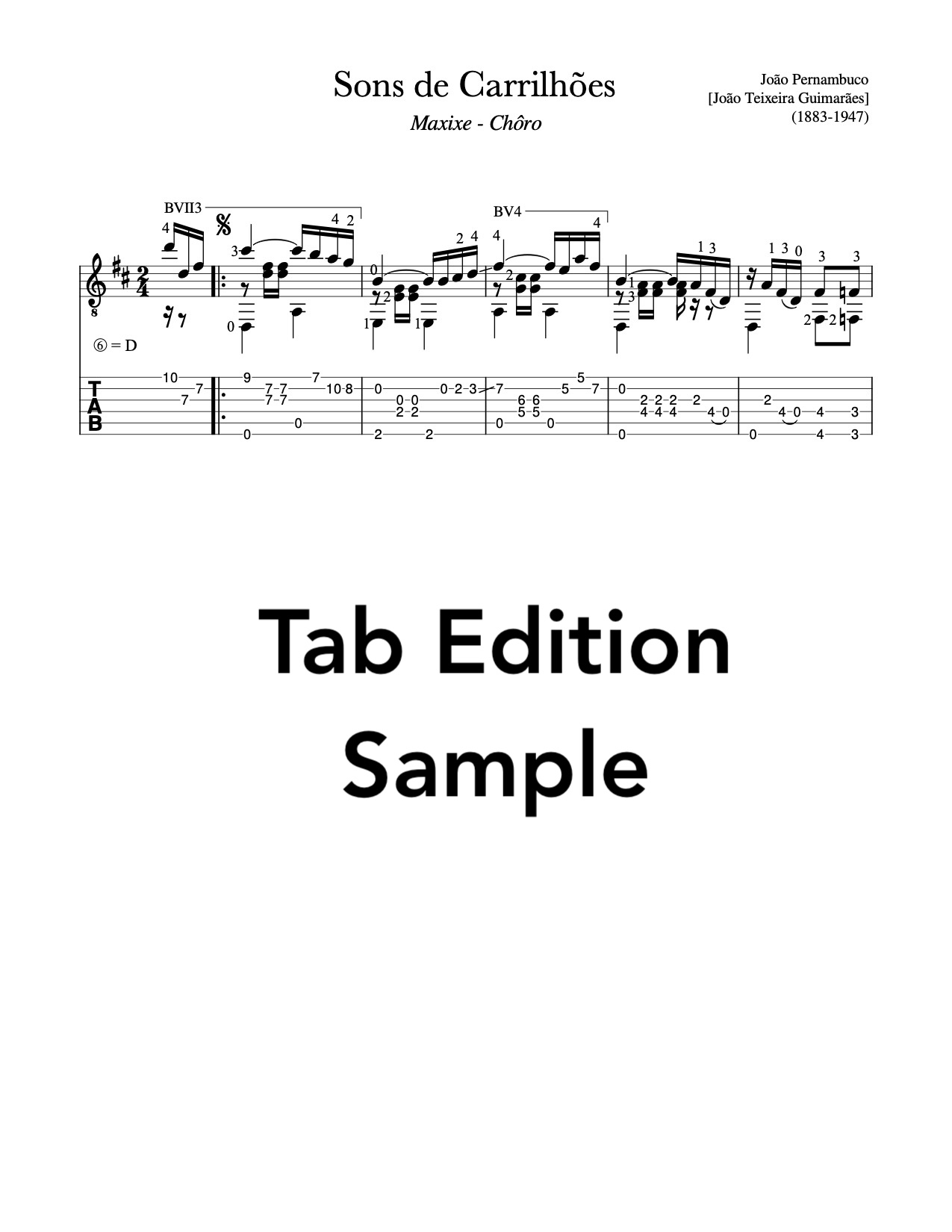
Sons de Carrilhões (Maxixe-Chôro) by João Pernambuco (1883-1947). PDF sheet music for classical guitar with performance and lesson video and practice tips. This edition comes with both a notation edition with left hand fingering and a separate tab edition in the same pdf. On this page you’ll also find a complete performance and walkthrough lesson with practice and interpretation advice. The level is intermediate (grade 6-8) depending on your desired tempo and level of refinement. Please note that this work is in Drop D (tune the 6th string down to D).
Sons de Carrilhões Sheet Music for Classical Guitar
- Sons de Carrilhões by Pernambuco (PDF) – This is my version from Werner Guitar Editions and matches the video above.
About João Pernambuco and Sons de Carrilhões
João Pernambuco (1883–1947) was a Brazilian guitarist and composer who played a major role in developing Brazilian guitar music. Born João Teixeira Guimarães in Pernambuco, Brazil, he became known for blending traditional Brazilian folk rhythms with classical guitar techniques. His compositions, especially Sons de Carrilhões, remain important in the classical guitar repertoire and influenced later Brazilian musicians and composers.
Sons de Carrilhões (often translated as Sounds of Bells) is one of the most popular works by Brazilian guitarist and composer João Pernambuco. The piece combines a memorable, bell-like melodic character with lively Brazilian rhythms and has become a favourite in the classical guitar repertoire.
Sons de Carrilhões Performance & Lesson Video Topics
- 00:00 Performance
- 2:37 Intro Discussion
- 8:41 Walkthrough Lesson
- YouTube Video Link
Difficulty and Grade Level
I generally recommend Sons de Carrilhões for intermediate guitarists around Grade 6–8, although the difficulty depends considerably on the chosen tempo.
Players should be comfortable with a fair amount of position changes, jumping into chord shapes, strong melodic playing, and maintaining a clear rhythmic character. Practicing at a slower tempo is particularly useful for coordinating the melody and accompaniment while keeping the musical phrasing relaxed.
Performance and Practice Tips
When learning Sons de Carrilhões, practice the melody on its own so that your focus is on the melody and it’s shaped and phrased nicely. Then aim for rhythmic clarity and secure fingering rather than speed. Practice difficult transitions separately and make sure the melodic line remains prominent above the accompaniment.
The characteristic rhythm and articulation are an important part of the style. The sixteenth note accompaniment pattern can be syncopated or played straight as written, both are perfectly acceptable. I use both rhythms which is also an acceptable stylistic practice especially when improvised (I pretty much plan mine out though). See my video above.
Here is an example of the rhythm being played straight as written. I’ve always known this version by David Russell and love it despite adding syncopation to my performance. Via this YouTube.
Here’s one mainly syncopated which is also lovely. This has become the more popular way to play the piece in the classical guitar world but both ways are acceptable. Via Tatyana’s Youtube.
My Promo Cover and Samples