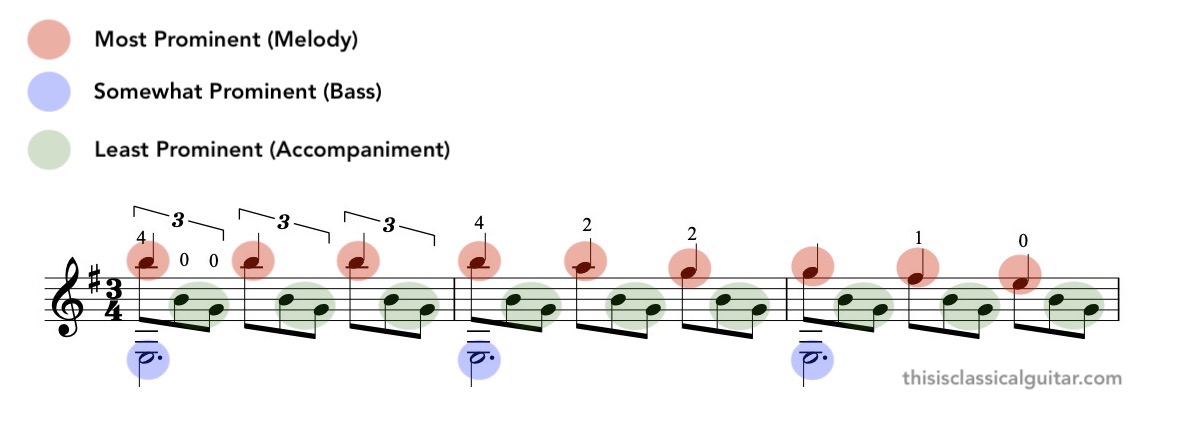
Question: How do I bring out the melody and/or other notes in a musical texture? I am having trouble bringing out the melody, especially if I’m playing several strings at once. If I play a chord with p,i,m,a, all the notes pretty much have the same volume. Is there guidance you could give me?
Answer Summary: To bring a note out of a texture or make a melody prominent requires both an examination of techniques used and also rebalancing of the dynamics in the texture itself. In the below lesson we will look at following the finger stroke through to the palm, the use of rest strokes in practice, looped repetition, and rebalancing the texture through exaggerated dynamics.
Here’s the YouTube Lesson Link if you don’t see the video above.
Follow through to the palm
When isolating a note to be prominent during free strokes, it can be helpful to bring the finger playing the note deeper into the palm. This is almost a magic trick as the mere act of a deeper follow-through will create an emphasized note. Just for practice, touch your palm with that finger. This is also useful when I teach because I don’t want to recommend playing “harder” with a finger. Instead, a deep follow-through to the palm pushes the string in toward the guitar in a similar way to a rest stroke.
Use rest-stroke accents in practice, then switch back to free strokes
Using a rest stroke on the prominent note and free strokes on the quieter notes builds a muscle memory of a deep stroke on the specific note and finger. Try playing the passage four times with rest strokes on the melody and then play it again with all free strokes. It is often the case that your fingers will automatically bring the note out due to the muscle memory of playing a rest stroke. Just be sure that you are keeping a good static hand position while mixing the strokes and not building any unhealthy tension.
Looped repetition
One of the first things I do when teaching a student a new piece is to take the first measure or beat, the main texture, and loop it to enter the desired balance into the hand’s muscle memory. This can even just be one chord or one melody note with accompaniment looped endlessly. It may take a few seconds to get the right balance but then you continue to play it to solidify it in your hands. This is a great way to start a piece before worrying about all the notes and chords you have to play, you just get the musical balance into your hands first.
Exaggerate and Re-Balance the Texture
It’s important to remember to not just accent or emphasize the melody but also to decrease the dynamic level of the accompaniment around the melody. Loudness is always relative to what is around it. If I play loud on the classical guitar I might think I’m playing loud but if I play next to a grand piano my forte becomes very soft in comparison.
I often have my students play the accompaniment on its own at ppp (very soft), almost inaudible. laughably quiet. After doing that for a few moments we play our melody at a simple mf (mezzo forte, medium loud) and it sounds super loud in comparison. A melody can be played soft as long as the accompaniment is much softer. It’s all relative to what’s sounding around it.
Spanish Romance Example
- Practice bringing the a finger (melody) further in-toward the palm
- Play the melody with rest-stroke accents 5 times and then use free strokes with the same emphasis and feeling of a rest stroke
- Loop the first beat over and over softening the accompaniment and bringing out the a finger until the balance is correct
- Exaggerate and rebalance it, make the accompaniment ridiculously soft.