
Question: How do I play through a simple mistake in music? For example, I have a habit of when I play a wrong note, I go back and correct it. It may not be a difficult passage, just a simple mistake. Am I just too much of a perfectionist?
Answer Summary: This is a very common issue for musicians and requires a restructuring of your priorities when playing and practicing music. If a simple note mistake is causing you to break rhythm and go back, you are emphasizing the notes as the highest priority and focus. Instead, you need to restructure your priorities and place rhythm, meter, and directional phrasing as the top priority. This is important for both yourself but also your audience and listeners.
Cautionary Note: This advice is for when you make a small random mistake. It is not for a mistake that is happening in the same spot every time which needs to be addressed. Always make sure you are playing music that is at a level and tempo that is appropriate to your skill. Also ensure you are taking enough breaks to be maintaining high levels of concentration when practicing.
Lets explore the ideas in more detail and also cover some activities you can do to re-prioritize the elements in your playing.
Rhythm and Meter as a Priority
In the majority of the music we play, rhythm and meter should be the higher priority musical element you are focused on. All of my favourite performers are on the ones who feel the rhythm and land on the beat regardless if the notes are correct. A break in rhythm or meter is far more noticeable in a performance than a wrong note because it breaks the phrasing, direction, and meter of the work. Whether you are playing in a group or solo for a listener, you are playing in an ensemble where everyone is feeling the beat. The listener and you are connected to the beat and you both want it intact.
Practical Tips:
- Play in an ensemble – Playing with others is the best way to build rhythm as a priority. When you play in an ensemble you have to continue on-beat since everyone else will continue playing. This take time to get used to. Once you get used to that, you can try playing your solo music imagining that you in an ensemble. In a way, when you play for others, the audience is your ensemble since they are feeling the beat with you.
- Improvising – Learning to improvise to a beat, metronome, or with a jam partner is another great way to prioritize rhythm. You can do this by simply noodling melodic lines with a simple C major scale. If you play a wrong note, no problem, just slide it up a fret for a jazzy sound but keep the beat.
- Tap your foot while playing – If your body is feeling the beat you’ll have a better chance at keeping the beat going even if you play wrong notes.
Musical Phrasing Instead of Note-to-Note Accuracy
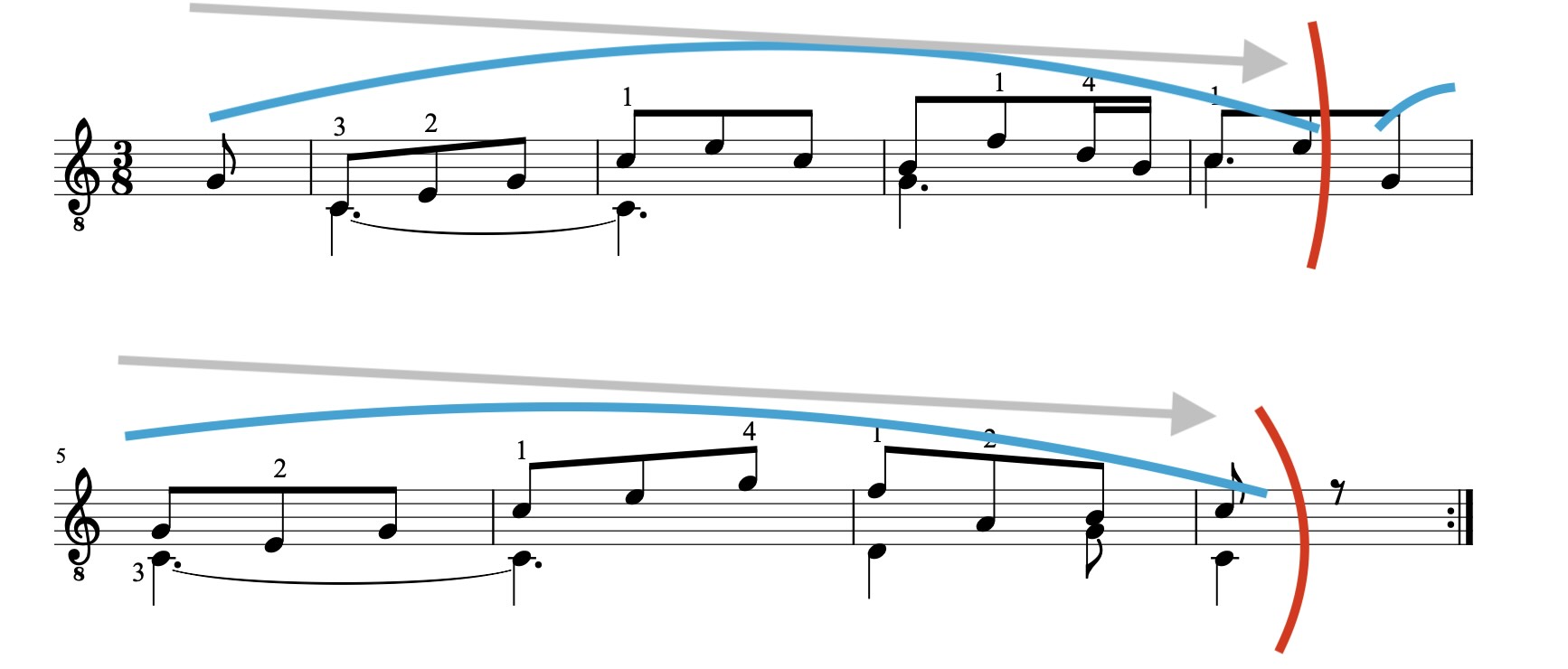
Once you’ve started thinking about rhythm and meter as a priority you can start thinking much more about directional phrasing and destination points. Music is very similar to language, notes are grouped together into words and paragraphs. A musical phrase might have 20 notes in it which means that individual notes are less important than the phrase as a whole. Once you realize this you can start deciding your destination points which will give you a goal to play toward.
Practical Tips:
- Mark your phrase destinations to play up to– Decide where your musical destinations are in the piece. If you have a singable line it is usually where you would take a breath. You can mark small phrases or larger ones that are more definitive. But it doesn’t matter too much, even mid-beginners can hear how small musical ideas are formed. Once you have a destination point marked in the score (or by memory), practice playing up to that destination point without breaking rhythm if you make a mistake. Keep it small so it’s an isolated experience you can concentrate on.
- Examine the reason for your mistake after playing the phrase to the destination. Make it clear to your brain and hands when it’s okay to stop and examine and when it’s not.
Start Small and Make it a Habit
You’ll want the above to become the normal way you practice and play. But this will take time to develop. Start by marking your phrasing or destination points and practice in small isolated chunks. Maybe you will only be able to do this for 5 minutes of your 45min practice session. As it becomes more of a habit you can increase it to 10 minutes and so on until it’s integrated into your playing.
At first this will require concentration to accomplish but later it will become a natural habit.
Questions & Support
If you need clarification on this particular Q&A please leave a comment below. For new and existing questions please visit the main Classical Guitar Q&A page. If you are enjoying the free Q&As you can support the site here.