
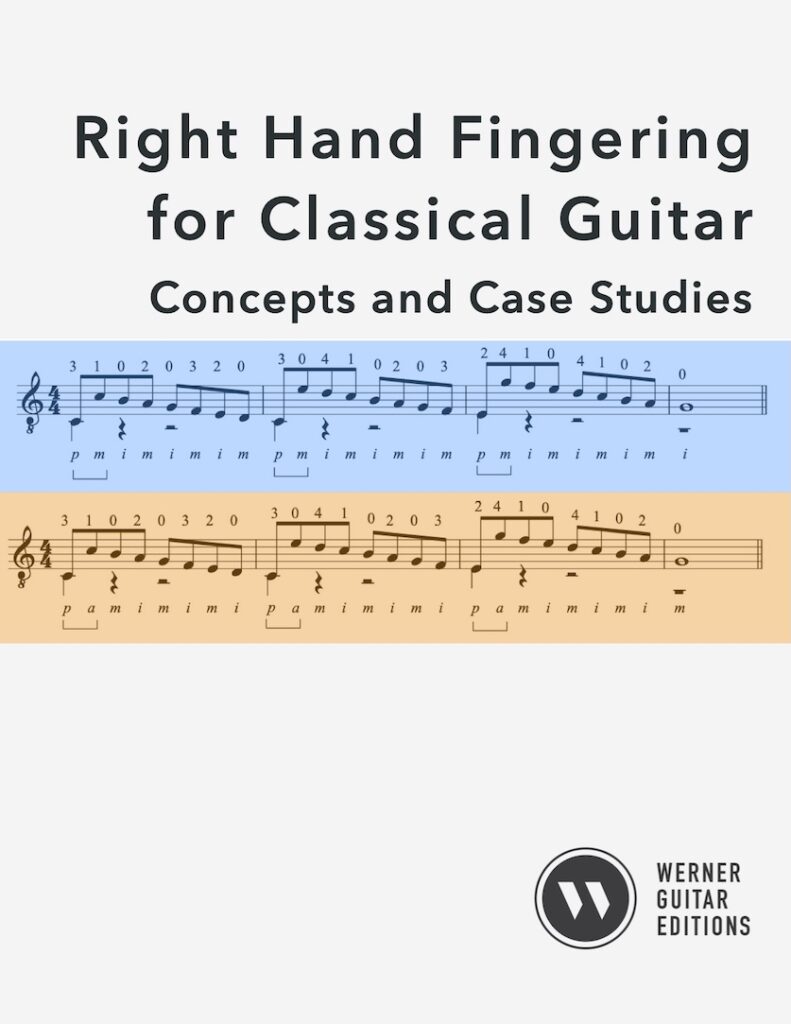
Right Hand Fingering for Classical Guitar: Concepts and Case Studies. This book aims to give students a basic criteria for justifying fingering choices and gaining confidence in deciding fingering for themselves. The combination of concepts and case studies offers a framework for approaching fingering in both logical and musical ways. This is a pdf download.
Buy the pdf booklet from my store
Included in this pdf booklet
- 58 pages of text and notation examples
- Notation-only with fingering
- Text explanations and debates
- Comparisons of fingerings
- Free video lessons for each concept and example
This is not a technique book – This is a book explaining what fingers are used for certain musical passages and why. It is not a book training right hand technique and playing ability. For technique training please see my book Classical Guitar Technique.
Level Recommendation – This book is for the intermediate student but can be beneficial to all levels either as an introduction to right hand fingering concepts or as a clarification of values for advanced students. Most conceptual examples are basic open string exercises attainable to beginners and all levels. However, the repertoire examples are mainly from the intermediate repertoire. Therefore, in order to gain maximum benefit from the case studies, a level of grade 4-7 is recommended.
Video Lessons and Contents
Concepts – This section forms a basic criteria for examining or choosing right hand fingering in a variety of musical textures.
- Alternation (Examples No.1-7)
- String Crossing and Ergonomics (Examples No.8-14)
- String Spacing and Ergonomics (Examples No.15-18)
- Rest Stroke and Free Stroke Considerations (Examples No.19-22)
- Repetition of a Single Finger (Examples No.23-25)
- Playing Arpeggios Across 5 & 6 Strings (Examples No.26-29)
- Voice Separation (Examples No.30-34)
Additional Thoughts – Clarity on how we approach fingering in a practical way and in the practice room.
- Spot Fingering (Exercises No.35-38)
- Feel vs Logic (Exercises No.39-40)
Case Studies and Comparisons – Using the concepts learned in the first section, multiple musical examples are examined and debated in the book. The video lessons will mainly discuss the primary fingering choice.
- Common Musical Textures (No.41-45)
- Alternation and Repeated Fingers (No.46-53)
- Playing Across the Strings (No.54-57)
- Thumb Use and Voice Separation (No.58-65)
- Additional Case Studies (No.66-68)
Final Advice
Supplemental Video Lessons
These lessons expand the contents of the book and add special circumstances. These are are either questions submitted by students or extra content not covered in the book.
Student Q&A
If you have a question about the book leave a comment below and I’ll organize the answers here.





I highly value every of your books I had an opportunity to use. Just one question: does it make sense to work with this one before finishing Giuliani 120 arpeggios?
Well, that depends on your goals. This book is not a technique or “improve your technique” playing book. This is really just an examination into fingering choices. That said, the Giuliani 120 would certainly be interesting to view through the lens of the criteria I’ve made here. It would most likely be connected to string spacing and crossings but still and excellent study.