
Theory Lesson No.6a: Pitch, Octave, Register, Octave Designation, and Pitch Class. In this lesson we have a more in depth discussion on pitch, the specific register of pitches and how we name them. This is an important lesson that will set us up for the next lesson on the sounding pitch of the guitar. Here’s the YouTube link if you want to watch it there.
Pitch, Frequency, Hertz
We’ve already had a basic conversation on pitch but here’s some more context on the term.
Pitch is how high or low a sound is, determined by the frequency of its vibrations. This can occur from any vibrating body whether it’s a violin, a human voice, a clarinet reed, or a plucked guitar string. Frequency is measured in hertz (Hz), or vibrations per second.
When frequency increases the pitch rises (higher pitch); when frequency decreases the pitch falls (lower pitch).
On a guitar, shortening a vibrating string raises its frequency, which is why pressing a fret produces a higher pitch compared to the open string.
Examples
- 110 Hz = 110 vibrations per second → relatively low pitch
- 440 Hz = 440 vibrations per second → the A above middle C
- 880 Hz = 880 vibrations per second → an A one octave higher
Keep in mind we are not having a discussion today on tuning or historical tuning in regards to what Hz represents what pitch, so if you are knowledgable in this area you’ll have to wait for a future lesson.
Octaves
An octave is the musical interval between one pitch and another with twice or half its frequency. The two pitches sound closely related and are given the same note name.
For example, “A” vibrating at 440 Hz and the A one octave higher vibrating at 880 Hz.
Octave Designation and Register
Here’s a diagram of Octave Designations – This allows us to pinpoint which octave is in use when referring to a pitch. Middle C is referred to as C4. I know, it’s an explosive concept.
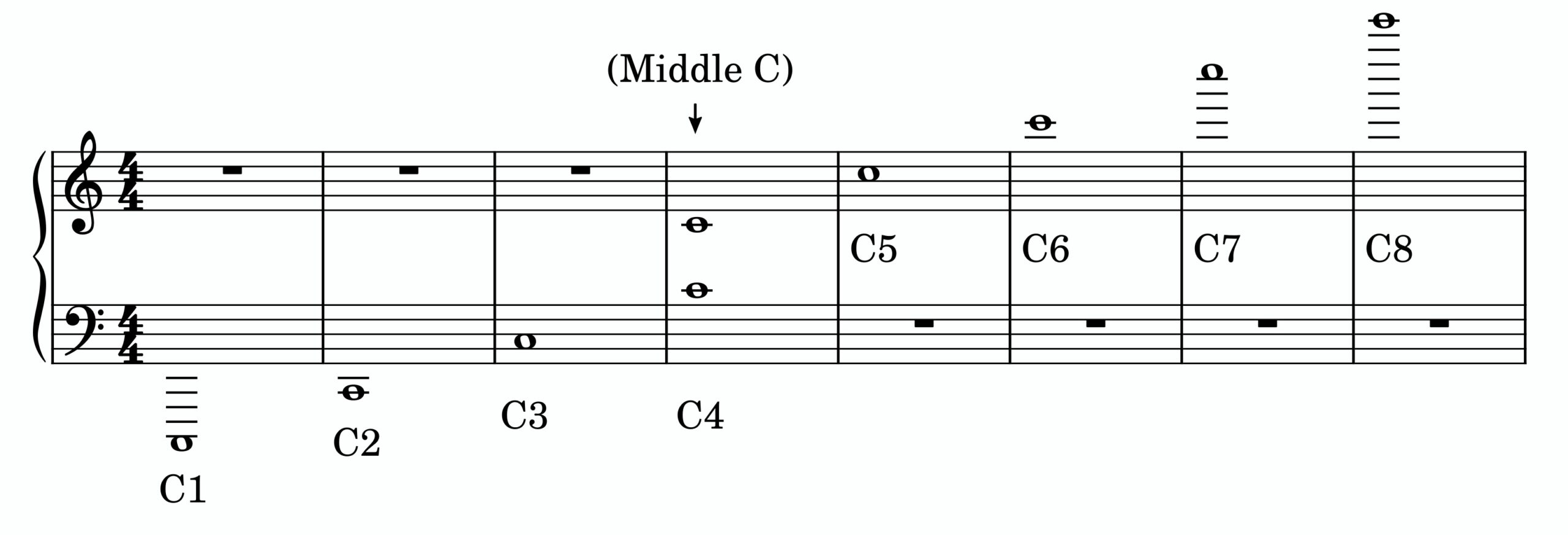
We refer to a pitch placement as its register. The register of the note tells us which “C” we are referring to, a high C or a low C.
For example, Middle C is referred to as C4, the octave below is referred to as C3. If I indicate C4, musicians will know which C I’m referring to.
The numbering system describes absolute pitch/register across instruments in a universal way. It lets us name the specific pitch we are talking about in terms of an exact register.
This will be important when discussing what pitch is used in a clef and for our next lesson on the actual sounding pitch of the guitar (hint, it’s one octave lower than written).
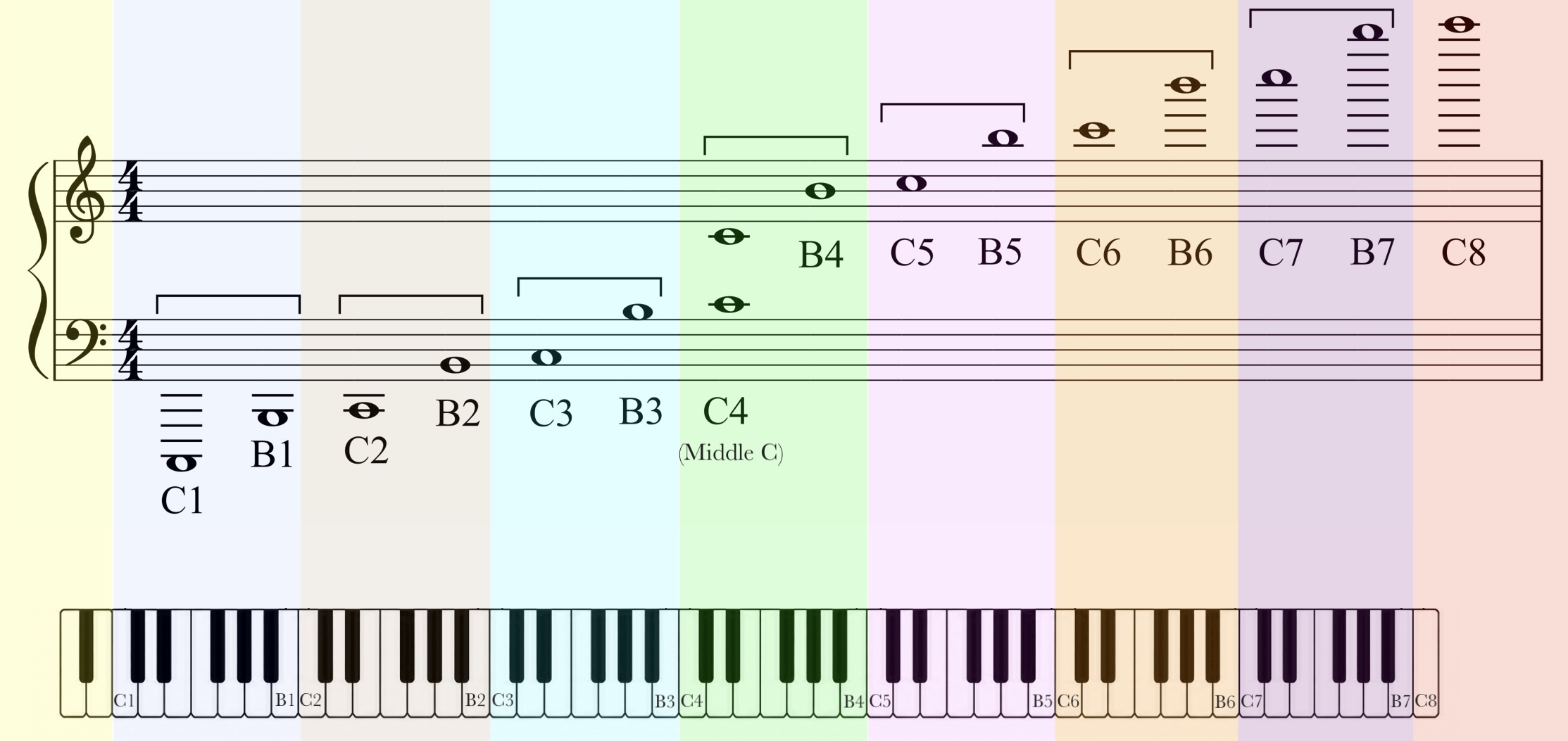
Here is the octave designation sections in notation and keyboard.
Pitch Class
We don’t always need to be specific about register so pitch class is a group of all pitches that share the same note name, regardless of octave.
For example, every C—low, middle, or high—belongs to the pitch class “C”.
Pitch class allows us to identify notes by name regardless of octave, making it easier to discuss scales, chords, and harmony without specifying which octave we are using.
Keep it simple
Todays lesson helps us understand the use of the word pitch. It distinguishes between very specific pitches in a register or generalized naming of a pitch.
Octave Designation = Specific register of a note
Pitch Class = Generalized note name
The only thing you really need to know for now is the term Octave. The rest is for context so when I give you more complex lessons you’ll know what I’m discussing.





Thank you, Bradford. I very much enjoyed your discussion on pitch, frequency and octaves. I did notice a small error on your color piano keys and pitch class. The note C5 is on the E.
Thank you again and am looking forward to your next lesson!
You are correct! I’ll correct that. Thanks!