
Asturias (Leyenda), No.5 from Suite Española, Op.47 by Isaac Albéniz (1860-1909). Performance, Lesson, and PDF Sheet Music for Classical Guitar. Comes with both a notation edition with left hand fingering and a separate tab edition in the same pdf. The level is fairly advanced (Grade 10) but see the FAQ below.
I’ve based this arrangement mainly on the piano score and my own ideas but I mention in the score and the video lesson a few changes you can make to either follow my edition or choose popular ideas such the use of harmonics in the middle section. Here’s the YouTube Link if you want to watch it there.
My PDF Sheet Music Edition – Includes both notation edition and a separate tab edition in the same pdf.
- Asturias by Albeniz from Werner Guitar Editions – my dedicated sheet music store.
Isaac Albéniz was a Spanish pianist, composer, and conductor. He is one of the foremost Spanish composers of the Post-Romantic era. He is best known for his piano works based on Spanish folk music idioms. He actually never wrote guitar music but was certainly influenced by it which explains why Asturias on guitar actually works quite nicely (tremolo and repeated notes are difficult on keyboard).
FAQ
What grade level is Asturias?
Asturias (Leyenda) is generally considered an early to mid-advanced classical guitar work (around Grade 9 or 10). But it really depends on your desired tempo and refinement. It requires strong endurance in your barre technique, expressive phrasing, and control of various textures. There are a few awkward chord shapes but it’s fairly manageable. The reason it’s upper level has a lot to do with it’s larger scope and the high level we are used to hearing it played by pros. 90% of the work is quite accessible to intermediates but the other 10% is clearly advanced.
Is Asturias suitable for intermediate players?
Not really no. Although intermediate can enjoy learning sections of the work, in order to play the entire piece at tempo it is generally not good for a student’s development and can cause frustration. That said, if a student wishes to play sections of the work for enjoyment that is perfectly fine. Most students should first learn some other upper level works before tackling this one. You can works listed by grade on the main sheet music page.
Can I download Asturias as a PDF?
Yes. My video matches the pdf sheet music and includes a professionally edited PDF with notation and a separate TAB edition. You can purchase it here: Asturias by Albeniz from Werner Guitar Editions
Who composed Asturias and what’s it’s story?
Asturias (Leyenda) is one of the most famous works in the classical guitar repertoire. It was composed by Isaac Albéniz in 1892 as a piano prelude in the collection Chants d’Espagne. Although it is now known as Asturias (Leyenda), the title Asturias was added later by a publisher after Albéniz’s death and was later republished posthumously as Asturias (Leyenda) in Suite Española, Op. 47. Despite its name, the music is inspired by the flamenco traditions of Andalusia in southern Spain rather than the northern region of Asturias. The piece became a cornerstone of the classical guitar repertoire through early guitar transcriptions and due to its driving rhythms, dramatic contrasts, and lyrical middle section which have made it one of the most recognizable and frequently performed works for classical guitar.
Sheet Music Samples
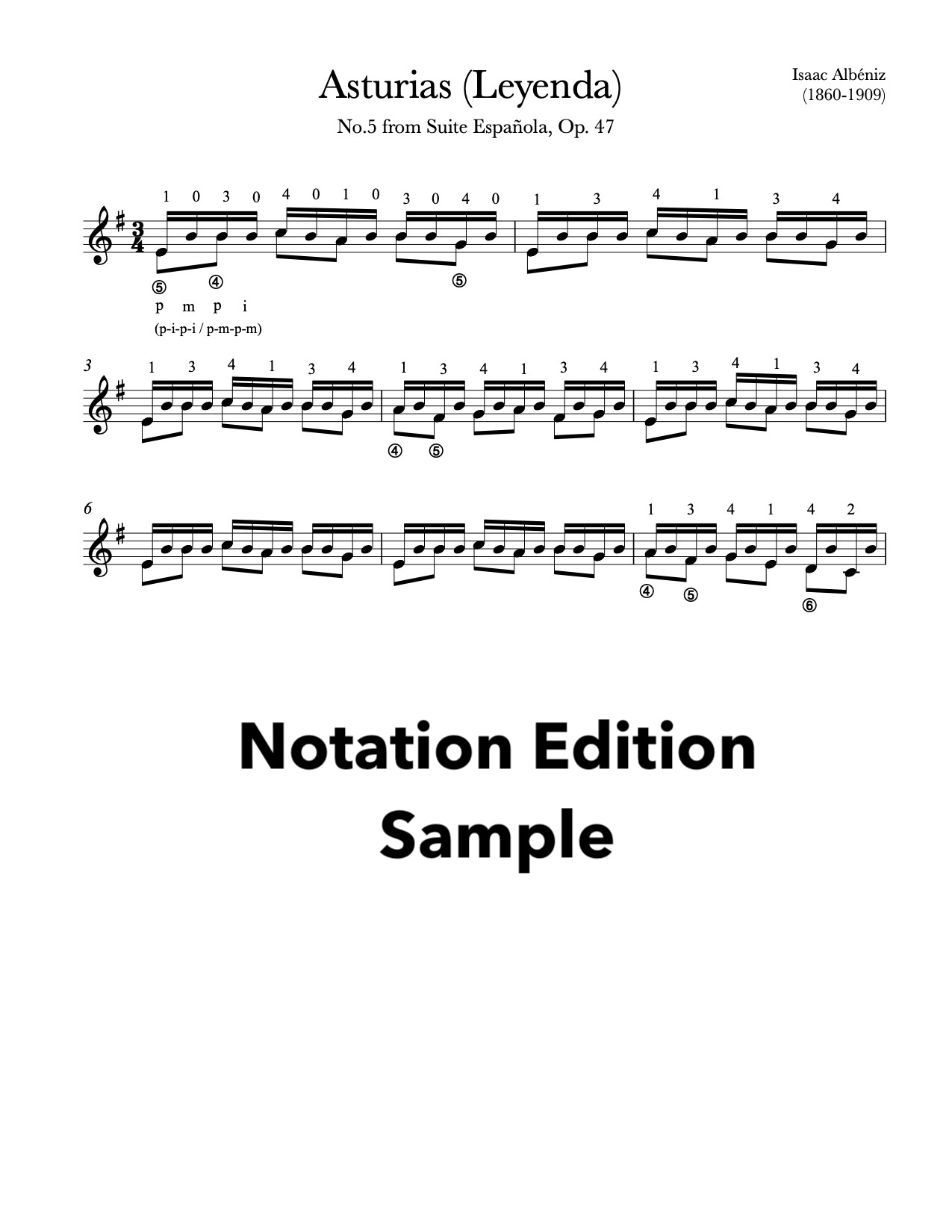
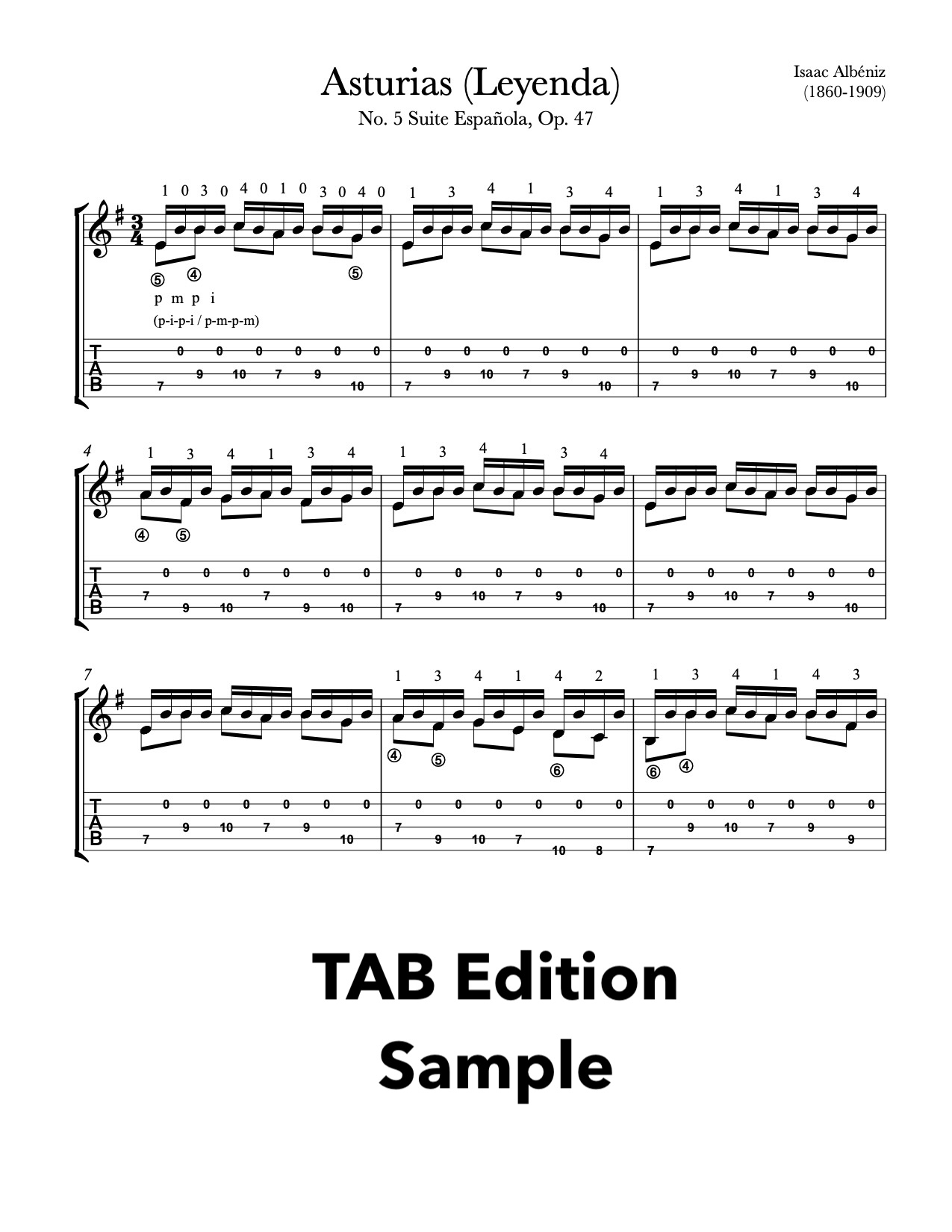
What’s Next? Improve your technique, play more beautifully!
Classical Guitar Technique: Essential Exercises, Scales, & Arpeggios – 122 pages with tons of video lessons. Everything you need to practice classical guitar technique.
Includes: Practice Routines, Tips, 100 Open String Exercises, 120 Giuliani Arpeggios, Selected Scales (Major, Minor, 3rds, 6ths, Octaves, 10ths), Slur Exercises, Shifts, Finger Independence, Alignment, Stretch, Barre, Tremolo, Common Harmonics, Speed and Relaxation, and more.
Progressive – Each section begins with easy exercises progressing to more advanced workouts.


Hi Bradford, recently bought your arrangement and rapidly coming to the conclusion that my teacher is a little misguided in thinking and I can tackle this at my stage of development. However, on a technical note, I am stumbling at Bar 15 where you use your second finger to cross to the A and my teacher insists on my just jumping there with my first finger, leaving the B and crossing to the A that way. But what I wanted to say is while your solution is way better, you don’t appear to be playing the D that starts the third beat of this bar. At least I watch and watch and don’t see it. Also in the score you have fingered it with a 1? Can you please clarify. Thanks, David.
Yes, measure 15 in my sheet music is fingered as I indeed to play it. That is the fingering I’m using. Because of the split second and intervening B you could use 1 on the A but I found that at faster speeds I could get more out of the B resonance by holding it longer with 1. I’ll make an updated video on the piece soon but I did check over the score recently and I think it’s how I intend.
ps. Always listen to your teacher! They often know what’s best for your unique development.
All your site is so helpful; many thanks
Hi Mr Werner, I was just wondering, how do your arrangement compare to Segovia’s?
Best wishes
I would say mine is a bit plainer in some ways. Not plain in a bad way, but more close to the original and a bit less ‘guitaristic’ in terms of effects etc. Maybe more ‘presentable’ if one could say such a thing. Both editions are good. With pieces this big you’ll want to get as many versions as possible and compare them to see what you like.
Mr Werner, would you please make a piece of La Caterdral for intermediate. I do like the rythm played by Mc Alister. Very much thank you.
THis is great ! But I am following you at page 46 of your method (volume 1). I hope you will have a detail guideline about this version someday. In fact, I prefer the version played by Sharon Isbin (here: https://www.youtube.com/watch?v=yIjfkYKKW54). Its like you are drinking a red wine. I heard John 16 years ago but he played it quick and strong not like Andrea Sagovia.
Great thanks any way. A silent online student of yours from Vietnam.
Clearly this is a beginner arrangement, hope you find it easier than the original. However, did you notice I have the original posted for free on the site: https://www.thisisclassicalguitar.com/asturias-leyenda-by-albeniz-free-pdf/
Hi, how do I download the original one?
Life took over, and after playing the classical guitar for 18 years, and being rather good at it, I stopped for 57 years.
I have now started again. It is very exciting as everything seems to be coming back, but the easy version is too easy.
I also tried to play Cavatina, but my hands are small, and I wonder whether there is an easier version.
Many thanks
The original is for piano, you can find it on imslp and elsewhere (google it!).