
Lesson: First Notes (E, B, G), Rhythms, Etude No. 1 & 2 – From my free PDF Method: Classical Guitar Method Vol. 1. All the lessons for the book are listed at the download page. This book teaches classical and fingerstyle guitar skills with a focus on the rich pedagogical tradition of classical guitar. Most learning objectives are covered through pieces and duets allowing students to perform full pieces from the first lesson. Youtube Lesson Link
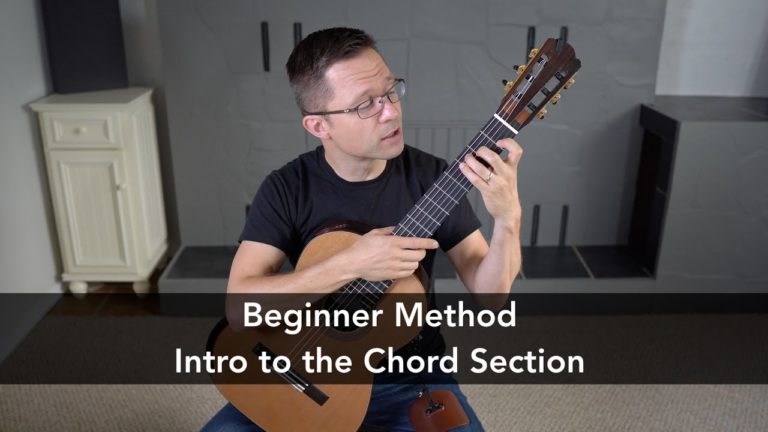
These are the first notes and pieces in the book and are designed so absolute beginners can start performing full pieces during the first lesson. The main goal is sit and hold the hands properly and learn to present music from start to finish. I cover how to play your first notes (E, B, G), the rhythms for Etude No.1, and Etude No.1 and No.2. Don’t forget to subscribe to my weekly newsletter for pro videos, inspiration, free lessons, and more.
Below is the old video lesson for the pieces in case you want to hear it all again with slightly different wording!

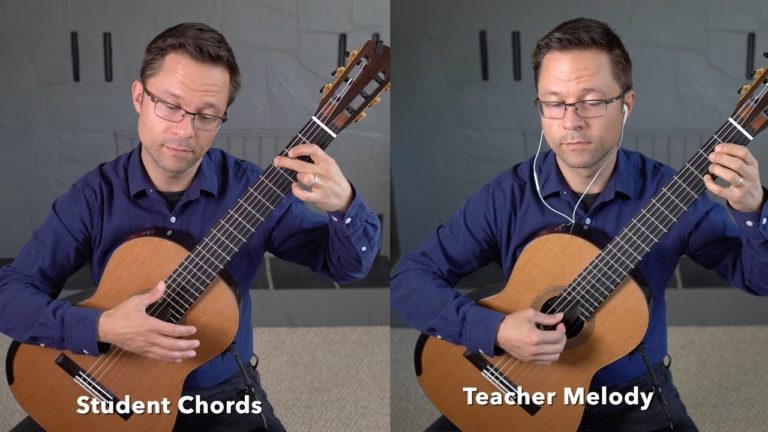
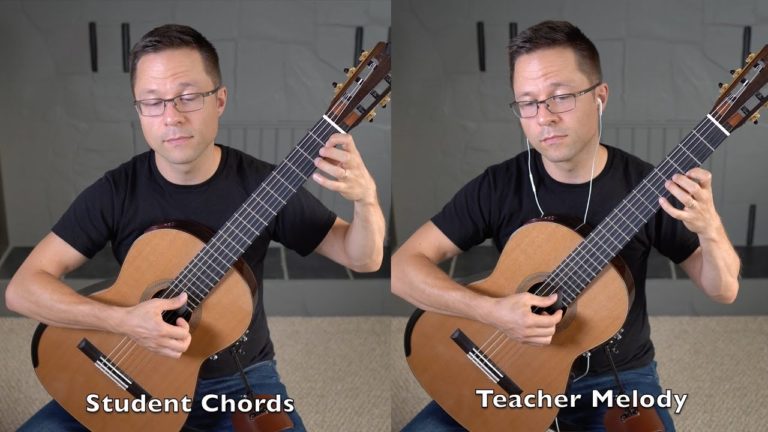
It’s amazing how many things are being worked on in such a simple exercise. I’m really enjoying it. I’m still adjusting to reading the staff and getting everything to work at the same time… years ago I learned a bit of tablature, so for now, I still get a bit confused; when I look at the staff lines, I’m reminded of guitar strings, and I need to unlearn that for the moment… because standard notation and tablature work in completely different ways. But it’s a great start; I assume it gets easier with time and practice, right? Thanks for these exercises! I’m loving the book!
Yes, it becomes as easy as reading a book. Of course, in a difficult piece that is fast it’s like reading a very complex book at a specific tempo but in general it becomes second nature.
Hello Professor Bradford, I always have doubts about how long I should practice an exercise before moving on to the next… I’m going to start practicing with your book vol. 1, how much time should I spend on each section/page? Thank you.
That really depends on the how much a student practices overall. Beginners can practice just 30min a day and increase that slowly as they improve. So each exercise/page can only be a short amount of time.
What an amazing resource – I am so hopeful! I’m retired, in my 60s and played guitar a little in my early teens. I desperately wanted to learn classical – but I have pretty bad co-ordination and I was too embarrassed to go take lessons. I am reading a book called The Stimulated Mind – among many things the author (a neuroscientist) talks about the value that learning and playing a musical instrument has in strengthening and protecting the brain against dementia. I sing in a community choir and had planned on learning to read music this year. But that book, your site and my husband’s unused guitar came together to convince me to learn to play. Do you have any advice for those of us who are (or feel we are) less co-ordinated than others?
Thank you
Michele
My main advice is to learn to enjoy practice sessions because it doesn’t matter how much you progress if you make it a special time that you enjoy. When I teach students it really doesn’t matter what their level of co-ordination is, they still need to learn the same skills and have an enjoyable time while doing it.
Hi Brad,
Firstly, thank you so much for the love and generosity in producing the material on your website. I had some classical guitar lesson a few years ago. Solely focussed on learning quite advanced repertoire (La Grima, Romaza) parrot fashion as an advancing finger style blues guitarist, I wanted to learn classical. I have moved to the highlands of Scotland and have no access to in-person lessons so your website is invaluable.
A couple of years ago I have purchased a few beginner repertoire pdfs from your site but have developed a habit of dipping in and out. I get bored easily.
Keen to get stuck in through the long dark winter days to learn to sight read I am working through your method books.
My query – When remembering the piece should I move on? It seems to bypass the point of playing by sight reading once you have finger memory? I think the reason I get bored by the piece so readily is that I can play quite technical pieces already. A problem I guess of an advanced “crossover” intermediate student?
Have you any advice how to handle this to progress my sight reading, classical learning without getting bored and quitting (again!)
Many thanks.
Wayne.
My main advice is to just practice sight reading everyday. Maybe that means 2 minutes a day or 20 minutes but it doesn’t matter. Doing it every day is the key. Keep it short enough that you don’t get bored. I have a sight reading post here: https://www.thisisclassicalguitar.com/sight-reading-music-on-classical-guitar/
Thank you for providing this amazing resource. I’m a 49-year old woman with quite small hands; my middle finger is only 3 inches long. I do have a full-size guitar and have not had too much difficulty with it yet, but I’m wondering if down the road it would make more sense to transition to something smaller. What has been your experience with students like myself?
If you are just starting out with classical guitar I would wait until you’ve progressed further. You might find as your technique and positioning improves, so does the feel of the guitar. In the meantime you can just try out smaller guitars as you get the chance.
Coming back to Classical Guitar after many years away, playing now everyday. Thank you so much for your instruction. You have made my retirement a very positive thing, I decided to work through all the lessons from the beginning, your instruction is truly inspiring. Thank you .
That is great to hear! Thanks for commenting.
You are amazing. Thank you so very much for sharing your experience and knowledge.
Wow. Etude 2 by Phillip Glass?
Ha, well, the etude is just arpeggios but yes, the reference is to Phillip Glass.
Thanks a ton Bradford for making out this book and video, I started learning through this book and video. Intresting…you are excellent music teacher.. God bless you.
Sivasankaran
Chennai
India
Hi, I have just started the classical guitar course and have a question regarding thumb pick. My nails are really short and every time I use my thumb it always hits the next string. I tried to use a thumb pick and it seems much better. Do you advise using thumb pick instead
I would recommend against the thumb pick. I usually start students out without nails. If you right hand position is correct and the knuckle relatively above the strings you should be able to have plenty of accuracy.