

Question: How do I get a beautiful right hand tone on classical guitar? I notice a “twangy “ sound when my finger strikes the guitar string a certain way, but a mellower sound when striking from a different position, but I don’t have consistency.
Answer Summary: The main tips for getting a nice tone on classical guitar are to consistently contact the string in the same spot from the same angle. You also need to pluck the string at an angle (not perpendicular), and direct the energy in toward the guitar rather than yank the string side to side. If you use nails you will need to have a specific nail shape and a multisided nail file to create a smooth ramp the string can glide along and release from. Let’s explore all these elements more closely below.
Tone Production Lesson
Let’s first take a look at my lesson Right Hand Tone Production, I’ve included my video below where I discuss right hand tasto and ponticello tone but also how to angle the finger on the string to create bright or warm sound. The more parallel I play the smoother and warmer it is, the more perpendicular I play the brighter it is. I also discuss how to play across the strings to compensate for string diameter. This also relies on having a good sitting position with guitar to some extent.
Nail Shape and Filing
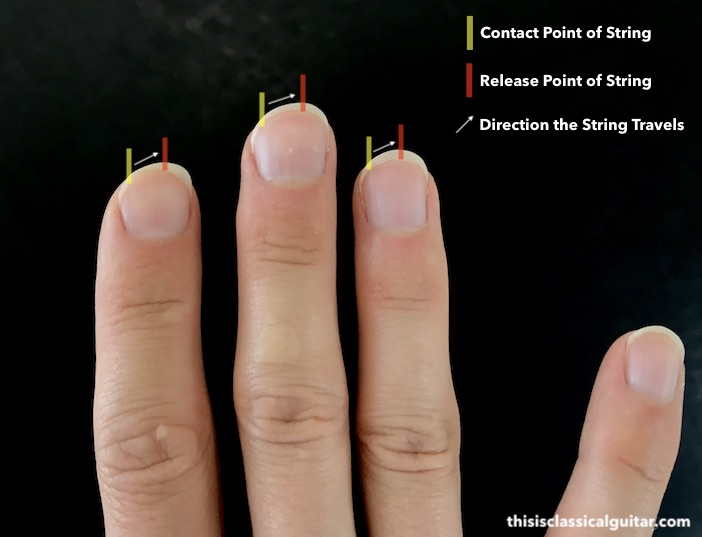
You also have to consider your nail shape and filing technique which you can learn about in my Fingernail Lesson for Classical Guitar. I’ve included the video and a diagram below but you should see the full article for all the information. Key to refinement here is also the filing process and the multisided nail file.
The diagram from the video:
Consistent Contact Point
One thing discussed in both of the above lessons is string contact. The contact point of flesh and nail at the bottom of the ramp or curve of the nail must be consistent so the stroke and sound is consistent each time.
You can practice your contact point precision by practicing via Right Hand Planting & Preparation. This will help secure your playing but also help you be more consistent with the exact and predictable contact point so you start each stroke in the same way.
Questions & Support
If you need clarification on this particular Q&A please leave a comment below. For new and existing questions please visit the main Classical Guitar Q&A page. If you are enjoying the free Q&As you can support the site here.





Hi Bradford. Thanks for your in-depth coverage of nail shaping. In the past years I have gone to classical guitar concerts by the Romero Quartet here in Southern California. I noticed that once they were onstage and before playing they would move their right hand to their face and appear to rub the tips and nails along the facial skin. I later met Pepe Romero in person and I asked him about this. He told me thay did that to put skin oil on their fingertips that acted as a lubricant and allowed the tip and nail to slide even more smoothy off the string. I started trying this in my guitar work and it acually works in aiding for a smooth stroke. Do you do this also?
I use shea butter or vaseline. Lots of pros actually put it on the guitar near the neck and dip into it on occasion in concert. The skin oil is a mild version of this.