
Question: Why can’t I play with a metronome? I don’t know why but find it to be distracting. I have tried the clicking ones and the blinking lights. Tapping my foot also distracts me.
Answer Summary: Playing with the metronome is something that sometimes needs progressive practice to develop the skill in a natural way rather than just turning it on and playing your pieces. The main advice here is that you want to feel the beat internally and then play along with that internal beat rather than trying to beat-match with precision.
Start simple by learning to tap your foot to music and then progress to playing open strings to the beat of music. When you start using the metronome begin with simple exercises and even rhythmic divisions. You want it to feel natural, relaxed, and casual so a slow progressive plan is helpful. Let’s explore this in more detail below with a 10 step plan. Don’t move to the next step until you feel confident.
How to Play with a Metronome – Video Lesson
Here’s the YouTube lesson link in case you need it.
Step 1: Tap your foot to music
Start by listening to some pop music with a regular beat. Don’t put on classical music yet, try something easier and obvious with drums and a consistent beat such as the Beatles or equivalent. Learn to tap your foot and clap to the music in a relaxed and natural way. Don’t worry about being precise, just feel the music first and then start tapping.
The goal is to make it a natural experience. For example, when sitting at the table eating lunch with music on, without thinking about it, you start tapping your foot to the music. That is the natural feel we are after. You want to reproduce that natural infusion of the beat in your body to your practice room sessions.
Try this with a variety of different popular styles of music that have a strong and obvious beat.
Step 2: Play an open string to the same music
Once you feel comfortable tapping along with the music, grab your guitar and play an open string instead of tapping your foot. Use the same music you were listening to before. The way you were tapping before, play the open string in the same way. It doesn’t matter if the pitch matches or not, you just want to feel the beat rather than try to match it intellectually.
If you have trouble, try tapping the beat with your foot eight times followed by playing the open string eight times. Playing the string is just another way of tapping. You can experiment with tapping to the beat with only your index finger on a table or the top of the guitar first.
Step 3: Play an open string and tap to the same music
Now try tapping your foot and playing an open string to the beat while listening to the music. Remember to feel the music first and then start tapping. You don’t want to try to beat-match with precision, instead, just casually feel the beat for awhile and then begin. Again, start with just tapping and then add the playing. You’ll be tapping and playing at the same time.
Step 4: Tap to the metronome
Set the metronome to approximately the same tempo as the music you were listening to; anything close is fine. Pretend the metronome is a wonderful piece of music, feel the beat and tap to it. Don’t beat-match, just listen to it and start tapping in a relaxed and casual way. We want this to feel like Step 1: natural, relaxed, and casual.
Step 5: Play an open string with the metronome
Similar to Step 2, play an open string to the beat. Feel the beat first as if the metronome was a pop song and then start playing. If you start trying to beat-match you aren’t feeling the beat. Stop and go back to a previous step.
Step 6: Tap and play with the metronome
Similar to Step 3, tap your foot along with the metronome beat and add the playing of the open string simultaneously. You’ll be tapping and playing at the same time on each click. If you can’t do this, go back to a previous step. Remember, feel the beat first, the way you did in step 1, and then start.
Step 7: Tap and Play rhythmic figures with the metronome
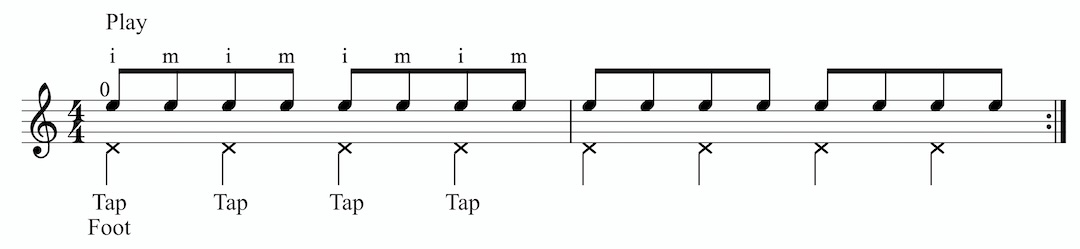
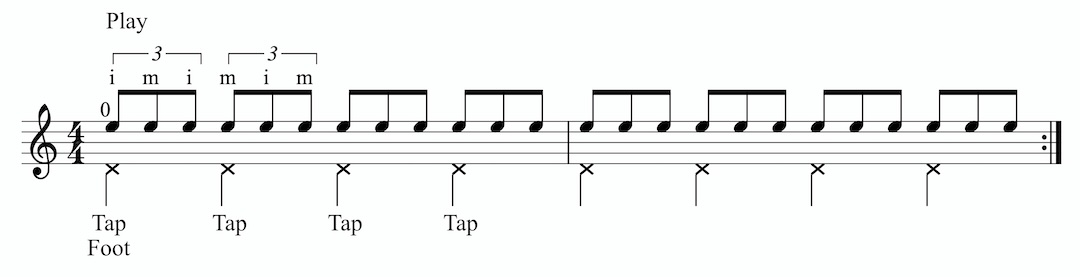
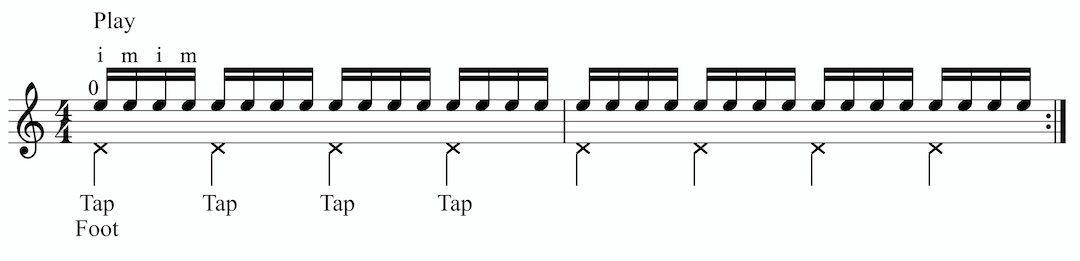
This step is very important. You want to feel the beat but play various rhythms over it. Start very simple and then progress to a variety of rhythms. You may have to stay on this step for a few weeks or months (I still do this everyday with scales and other technique exercises).
Start with tapping the beat with your foot as quarter notes and playing eighth notes on an open string.
Try with triplets
Try sixteenths
Variation with Tap
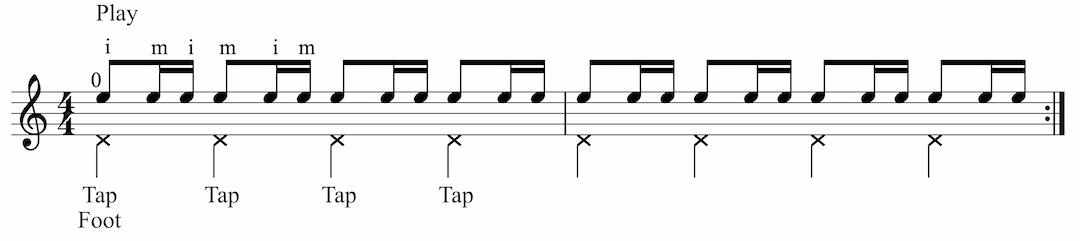
Dotted Figure with Tab
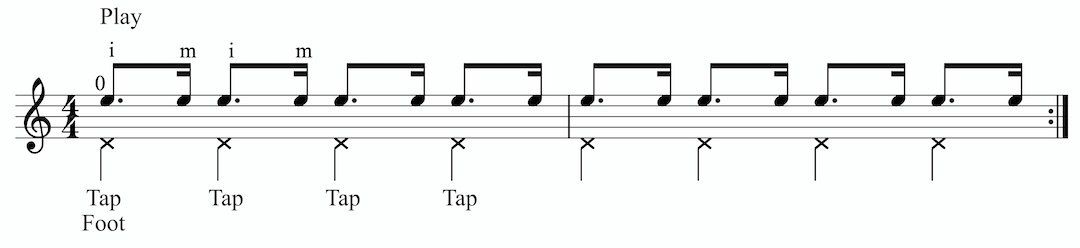
Repeat all with tapping your foot to the beat and playing the various rhythms.
Step 8: Play simple technique exercises with the metronome
You can now progress to playing simple technique exercises with the metronome. Start with something simple such as a one octave scale playing each note on the beat. You can then try playing the scale in eighth notes, triplets, and sixteenth notes. Even try dotted figures.
The reason you want to use an exercise is that you may not be ready for the variety of rhythms encountered in repertoire. Exercises are usually short, consistent, and can be looped (repeated).
Step 9: Play beginner method book pieces with the metronome
You’ve made it! You can now play with the metronome but don’t push your multitasking abilities too far too fast. For 5 mins a day play a beginner method book piece with the metronome. This is have more rhythmic and playing variety than an exercise.
Step 10: Work your way up to your level
Slowly playing more challenging pieces with the metronome during a dedicated part of your practice session. For example, if you are a grade 3 player, play a few pieces from grade 1 and then a few from grade 2. This might take days or it might take months but just do it for 5 minutes a day as a dedicated skill building session.
Support
If you need any clarification on this particular Q&A please leave a comment below. Also visit the main Classical Guitar Q&A page. If you are enjoying the free lessons you can support the site here.





Thank you so much for this. When you mentioned beat match I realized that is exactly what I was trying to do. I am sure following these steps I will get more comfortable with the metronome.