

Question: How do I play rest stroke thumb with free stroke fingers at the same time on classical guitar?
Variant: How do I play free stroke thumb with rest stroke fingers?
Answer Summary: The ability to play each technique separately and to have a rest stroke technique that is relaxed, smooth-moving across the strings, and predictable is key to success. Proper finger movement and planting (preparation) technique also contribute to a simultaneous release. But there are other variables depending on the level of the student, their skills with each individual technique, relaxation, confidence, nail shape, and more. Let’s explore what’s needed in more detail.
Here is the YouTube link in case you want to watch it there.
Rest and Free Stroke Ability
Here are some combinations that need to be practiced before attempting to play a rest stroke with simultaneous free stroke.
- Free stroke thumb
- Rest stroke thumb
- Free stroke fingers
- Rest stroke fingers
- Alternating one note rest stroke and one note free stroke continuously
- Free stroke thumb and fingers together
There are two key elements important to the above:
- The ability to play flowing rest strokes that glide through the string easily and predictably. This is usually taught by developing a very light, relaxed, and flowing rest stroke. Later, the stroke can be more intense but without losing the easy glide across the strings.
- The ability to keep your right hand in the same position for both rest stroke and free stroke.
Try This: Alternating one-note-rest-stroke followed by two-notes-free-stroke continuously with i-m without a hand position change. This is essential and will allow you to combine the two techniques using only one hand position. Having different hand positions for each technique will making it very difficult to play them together.
Additional Tips for Simultaneous Release
Movement and Nails – Predictably of the stroke will result in simultaneous release from the finger or thumb. If you are not using nails, focus on the movement of the fingers through the string. If you use nails, make sure your nails are of somewhat even length and that the release is smooth and easy. See my nail lesson here.
Contact Point – Having a consistent contact point and release point on the fingertip or nail is very important. See my nail article even if you play without nails as the diagrams explain it.
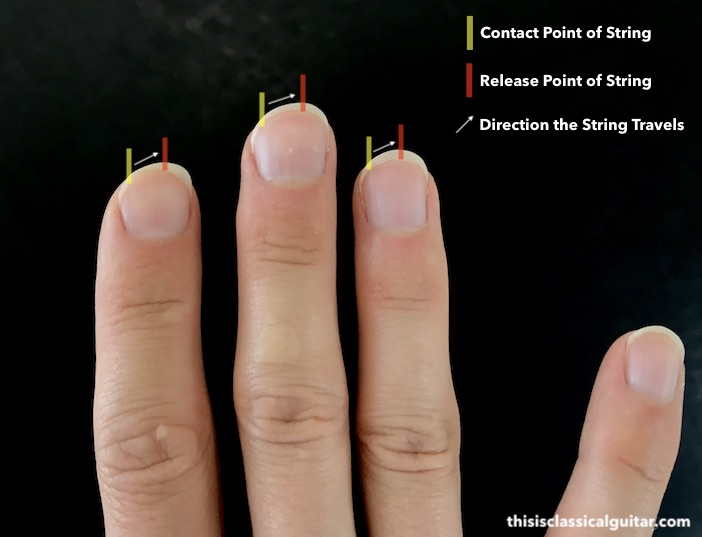
Planting – When beginning to combine the two techniques try using long-contact planting in the right hand. Planting is a preparation on the string where contact is made and held before the stroke is executed. Be sure the plant places the string at the exact same spot on the fingertip (or fingertip with nail) so the stroke will be the same each time. A long-contact plant with a confident stroke will result in more predictability.
Move the fingers into the palm with confidence – Hesitation or trying to micromanage the technique will likely result in random release times.
You’ve made it really far! Remember that if you are even playing this at all you’ve come a long way. Congratulations. But now you are in the refinement stage which is a great place to be. It may take some time to work this out but just dedicate a few minutes a day to it and enjoy your practice session.
Questions & Support
If you need clarification on this particular Q&A please leave a comment below. For new and existing questions please visit the main Classical Guitar Q&A page. If you are enjoying the free Q&As you can support the site here.




great explanation. just happens that I am at this moment refining my rt hand technique
thanks again
P. Hancock