Question: How can I play cleanly without looking at the left hand (fretting hand) on classical guitar?
Answer Summary: A combination of technique practice and muscle memory, string crossing and shift exercises, and some dedicated practice looking away eventually results in the ability to play well and clean without looking at the left hand on classical guitar. In this lesson we explore the elements involved as well as specific exercises to practice.
What is required?
Longterm technique training resulting in muscle memory – Having a well rounded technique routine is key to building muscle memory and the ability to look away from the left hand. The better you know and memorize your routine the more you can solidify the muscle memory. You want to look at your hand at first and have a high level of accuracy before looking away. Then, once your success rate is high you can start experimenting with looking away from the left hand.
Dedicated practice looking away – For 5 minutes a day you can try dedicated practice looking away. I’d start with a position scale at first. Once you are comfortable with that you can add position scale that includes a shift. As mentioned above, look when learning it at first and have a high level of accuracy before looking away.
Problem solving – Everyone has strengths and weaknesses they need to work on, it’s a natural part of learning music. This includes techniques that are not as confident as we’d like. It is often the case that if a student can not accomplish a basic position shift without looking they might have a technique deficiency in shift technique itself. In this case, shifts should become a regular technique that gets work and daily practice before experimenting with looking away.
Exercises to Practice
In general, all technique exercises will help with muscle memory but a few specific types of exercise will help solidify the basics before more advanced situations.
Position Playing – Solid first position playing as well as position playing in a “one-finger-per-fret” position is needed as a first requirement of trusting the left hand. Being able to play in one 4-fret location without shifts is absolutely necessary.
Shifts – Shifts are often the point where looking away creates the opportunity for error. Practicing dedicated shift exercises will teach your left hand the distance between the frets and do it in an organized and systematic way.
String Crossings and Jumps – Additionally, jumping between string groups in static positions or including with shifts is needed to gain confidence.
Finger independence – I find finger independence exercises very beneficial to left hand awareness and stability overall which can very much affect accuracy. If a student is changing hand positions when they should be keeping a static position and letting the fingers do the work is a clear indication of instability.
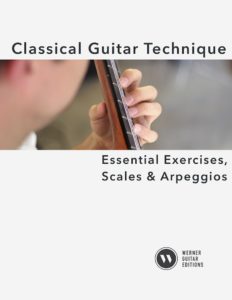
Recommended Technique Book: Classical Guitar Technique: Essential Exercises, Scales, and Arpeggios (PDF or hardcopy). It’s a full technique book with 122 pages and video lessons for all the content making it great for students who want both a book full of exercises but also online video guidance for each exercise. It includes progressive exercises and tips as well as practice routines for different levels. The book guides students from grade 1 to advanced levels.
It’s Okay to Look Sometimes
It’s perfectly acceptable to look at your left hand providing it’s not too static (as in, you are twisting yur spine or neck for long periods) or something you can’t look away from. That said, sight reading is certainly a situation where looking away is not a possibility. The other situation is pieces that you know but don’t have memorized in which I recommend spot looking.
Spot Looking – On my scores that I don’t have memorized, I circle specific spots that need a visual aid. Most of the time this is a difficult shift to upper position or a tricky chord shape. In these cases I memorize the single moment or measure of music and look at my left hand briefly to accomplish the difficulty. Circling it on the score is useful because you don’t want to be disoriented when you look back at the score (as in, loosing your place).
Support
If you need any clarification on this particular Q&A please leave a comment below. Also visit the main Classical Guitar Q&A page. If you are enjoying the free lessons you can support the site here.