
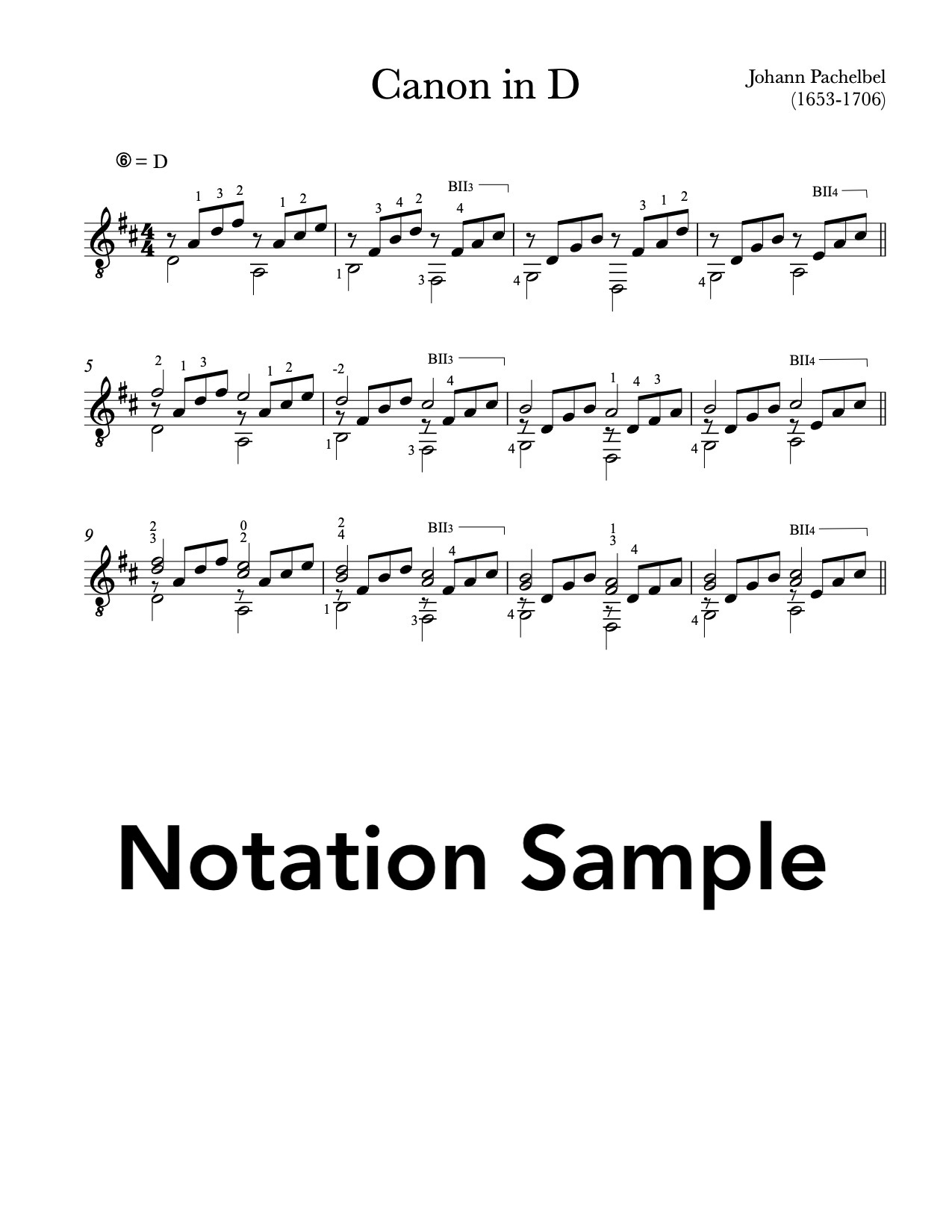
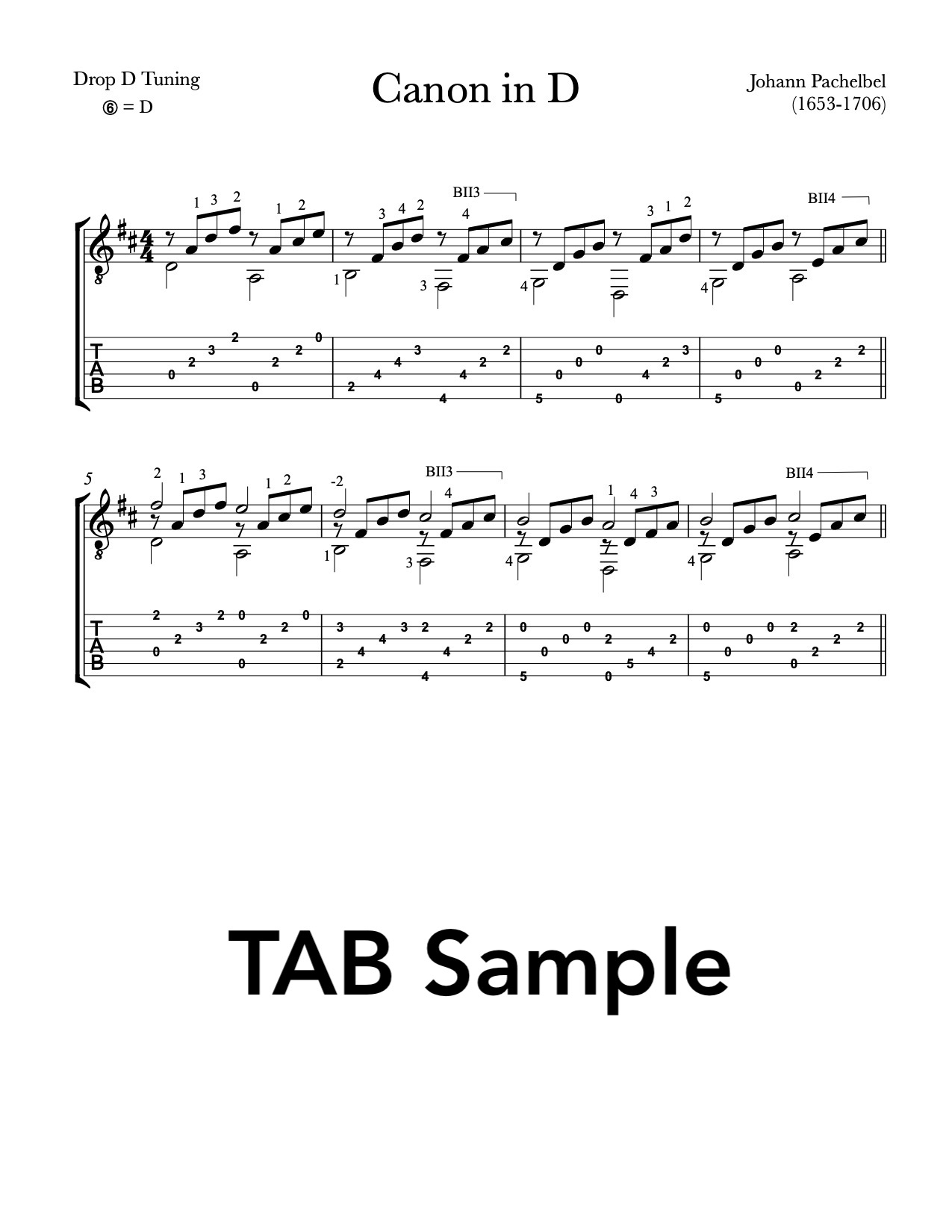
Canon in D for Guitar by Johann Pachelbel (1653-1706), arranged for classical guitar. This free PDF includes both a standard notation edition with left-hand fingering and a separate TAB edition in the same pdf. The arrangement uses drop-D tuning (6th string tuned down to D) and is approximately intermediate level (Grade 5).
This arrangement is designed to be practical for students, performances, weddings, and gigs. I’ve kept it relatively short and approachable while including the most recognizable sections of Pachelbel’s famous Canon. Lower level students can repeat the opening sections to create an easy performance. The lesson and performance video below demonstrates the arrangement and explains the drop-D tuning.
Free Canon in D Guitar Sheet Music & TAB
Arrangement Info
This has been arranged for use in weddings and gigs or for students. I’ve tried to keep it simple and short enough to sight-read at gigs yet provide some of the classic and recognizable sections of the work. Here’s the YouTube Video lesson Link if you want to watch it there.
You can also check out my article on how to play at weddings. Join the Email Newsletter to get updates or help support the site.
How to Play Canon in D on Guitar
See the video above for my full lesson and performance but here is a breakdown of some essential tips.
Ground bass: An eight-note bass pattern repeats throughout the Canon: D–A–B–F♯–G–D–G–A. This is the foundation of the word and since it continuously repeats it is one of the most recognizable elements of the work. Practice the bass on its own until you have it sustained and connected.
Harmony: The repeating progression is I–V–vi–iii–IV–I–IV–V in D major, giving the piece its characteristic sense of continuous forward motion and resolution. Canon: Three violin parts enter successively with essentially the same melodic material, creating overlapping contrapuntal lines. It would be easy to think of the piece as just chords on guitar but you should try to make the bass, upper line, and middle accompaniment distinct parts with their own musical balance. The bass and upper notes can be the most present while the inner accompaniment can be softer.
Variation: While the harmony remains largely constant, the upper parts become progressively more active, moving from longer note values into increasingly elaborate eighth- and sixteenth-note patterns. This is important because if you are not comfortable playing the whole piece you can repeat the sections within double barlines to make the piece longer while leaving out the sections you are unable to play.
About Pachelbel’s Canon in D
Johann Pachelbel (1653–1706) was a German Baroque composer, organist, and teacher known especially for his keyboard and sacred music. Today, his best-known work is the Canon in D, commonly performed at weddings and other ceremonial occasions.
The piece comes from Pachelbel’s Canon and Gigue for Three Violins and Basso Continuo in D major. (German: Kanon und Gigue für 3 Violinen mit Generalbaß) (PWC 37, T. 337, PC 358). The exact date and circumstances of its composition are uncertain, although it was probably written sometime during the late 17th century.
The Canon is built over a repeating bass progression while the three violin parts enter successively and become increasingly active. Although originally written for strings and continuo rather than guitar, its repeating harmony and melodic patterns adapt particularly well to fingerstyle and classical guitar.
This guitar arrangement uses drop-D tuning, lowering the sixth string from E to D. The low open D works especially well for the piece’s key and bass line while allowing the upper voices to be played more comfortably on the guitar.
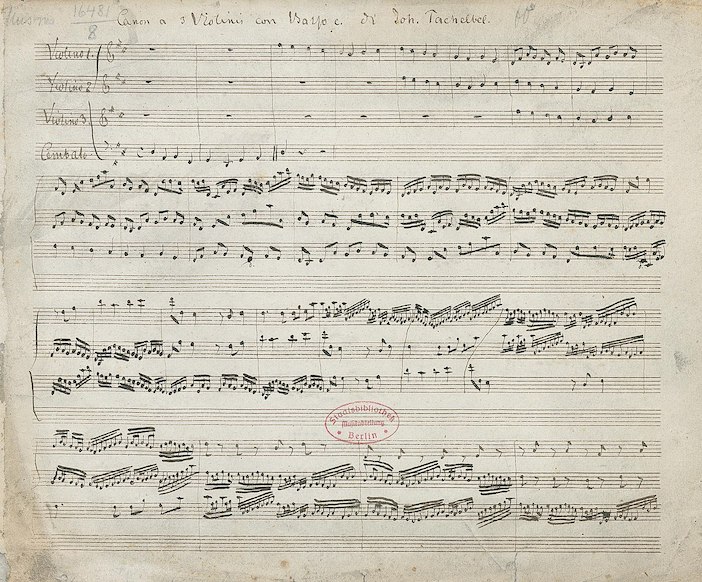
Neither the date nor the circumstances of its composition are known (suggested dates range from 1680 to 1706), and the oldest surviving manuscript copy of the piece dates from the 19th century. Here’s the first page of the original organ score. The canon was originally scored for three violins and basso continuo and paired with a gigue. Both movements are in the key of D major. Although a true canon at the unison in three parts, it also has elements of a chaconne.
Arrangement Details
| Composer | Johann Pachelbel (1653–1706) |
| Arrangement by | Bradford Werner |
| Level | Intermediate / Grade 5 |
| Tuning | Drop D |
| Format | PDF, notation, and separate TAB |
| Instrument | Classical or fingerstyle guitar |
Samples and Promo Cover
Other Great Wedding Selections
- Schubert: Ave Maria Arrangement, Grade 4, Romantic
- Bach: Air ‘On the G String’, Wedding Classic
- Bist du bei mir (Be thou with me) by Bach & Stölzel, Grade 6
- Bach: Jesu, Joy of Man’s Desiring, Great for the signing
- Bach: Prelude, Cello Suite BWV 1007 – Great for the signing
- Sheep May Safely Graze, BWV 208 by Bach, Grade 6
- Celtic: The Skye Boat Song (Outlander Theme)
Check out more Sheet Music
- Classical Guitar Method – Vol. 1, with Video Lessons, 100 pages, Free PDF
- Classical Guitar Method Vol. 2, with Video Lessons, 89 pages.
- Classical Guitar Technique: Essential Exercises, Scales, & Arpeggios – Hundreds of exercises and tons of video lessons. Notation.
- 20 Favorite Exercises, Technique book includes notation and TAB, Video lessons.
- Easy Classical Guitar, Volume 1, Authentic Works, Grade 1-3
- Easy Classical Guitar Volume 2, Authentic Works, Grade 1-4
- Easy Celtic Guitar Volume 1, Arrangements, Grade 1-4
- Easy Celtic Guitar Volume 2, Arrangements, Grade 1-4

I know I shouldn’t practice this yet as a (late) beginner, but it so lovely, and fun to try. I just listened to it in a performance with two baroque violins, a viola da gamba and a cembalo. It is one of those magic pieces you wish will never end.
I came across your website while searching for information on classical guitars. I started guitar a few months ago. I viewed your website and saw the video where you were playing Pachelbel’s Canon in D and I had goosebumps. I’m having trouble with left hand and stretching my fingers. I now have a renewed determination that I will learn to play guitar. I’m determined to conquer the left hand and learn classical guitar.
Glad you enjoyed it. You can check out this article on left hand stretches